
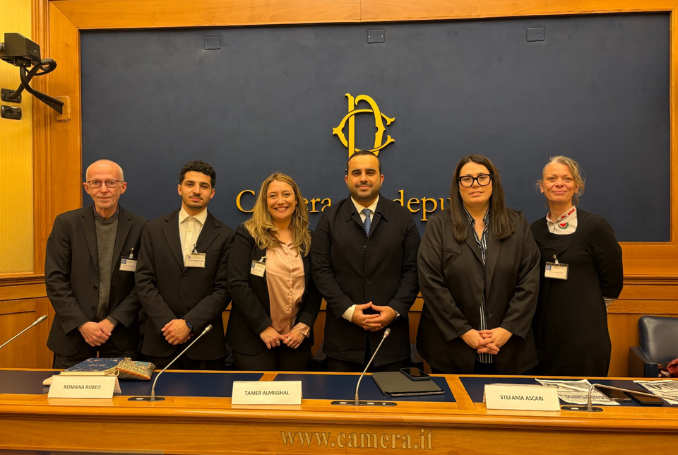
A press conference titled “The Story of Little Hind Rajab” was held on Thursday at the Italian Chamber of Deputies in Rome, organized by Five Star Movement parliamentarian Stefania Ascari.
At the center of the event was the investigation led by Palestinian Al-Jazeera journalist Tamer Almisshal, who meticulously reconstructed the killing of six-year-old Hind Rajab and her family during an Israeli military operation in Gaza.
After screening the full documentary, Almisshal outlined the stages of his work and explained that the reconstruction of the events was made possible through cross-referencing testimonies, audiovisual material, and documents obtained from Israeli military sources.
He stated that the investigation identified at least 30,000 Israeli officers and soldiers directly or indirectly involved in the military operations in Gaza since the beginning of the assault.
Almisshal also paid tribute to the Palestinian journalists who contributed to gathering evidence on the ground, foremost among them Ismail Al-Ghoul, who was killed by the Israeli army on January 14, 2025.
“Their work is the foundation of our ability to document what is happening,” he said.
He further revealed that he received numerous death threats while working on the investigation, yet affirmed that such intimidation will not stop his mission to continue reporting the truth.
A significant part of his presentation focused on what he calls the ‘Vampire Empire’—a network of individuals and operational units which, according to the investigation, contributes to the normalization and systematic execution of violence.
Within this framework, Almisshal highlighted figures such as Shon Glass, who sees himself as an ideologue and theorist promoting an eliminationist vision toward Palestinians, and Ariel Zuckerman, an Israeli-German national described as a war influencer engaged in producing and circulating media content that legitimizes and sensationalizes military operations.
The event was moderated by Romana Rubeo, managing editor of The Palestine Chronicle, who emphasized that in the current context of complete impunity granted to Israel, investigative journalism remains one of the most concrete and immediate tools available to document crimes and identify those responsible.
Rubeo stressed that, in the absence of effective international mechanisms capable of halting Israeli impunity, Palestinian-led investigative journalism becomes a form of safeguarding memory, truth, and the pursuit of justice.
Following the discussion, Riccardo Noury, spokesperson for Amnesty International Italy, and Michela Arricale, jurist at CRED and co-president of the Center for Research and Democratic Development, took the floor.
Noury stressed that the genocide against the Palestinian population is not merely a topic of academic or legal debate, but an ongoing reality facilitated by the complicity of Western governments. He noted that several countries, including Germany, have resumed or increased arms transfers to Israel despite mounting evidence of grave violations of international humanitarian law.
Arricale addressed the legal implications, underscoring that states do not simply have the option—but the legal obligation—to prevent, prosecute, and halt international crimes, including genocide, war crimes, and crimes against humanity. She also highlighted that documentation produced by investigative journalists may serve as key evidence in future international legal proceedings.
In closing, MP Stefania Ascari recalled the responsibility of Italian institutions to ensure that testimonies, documentation, and demands for accountability do not remain without political consequence.
She announced her intention to continue bringing these issues into parliamentary debate, promoting spaces for hearing, scrutiny, and institutional pressure to ensure compliance with international law and justice for civilian victims.